
Previous State of Things
Over the past decade of building software teams, one recurring frustration stands out: requirement leakage between Business, Design, and Development.
The traditional product requirements funnel looked like this:
- Stakeholder Interviews: Business Analyst or Product Manager
- Business Analysis: Business Analyst or Product Manager
- Design Specifications: UX Designer
- Technical Validation: Tech Lead or Software Architect
- Formal Requirements Breakdown: Project or Product Manager
- Execution: Tech Team
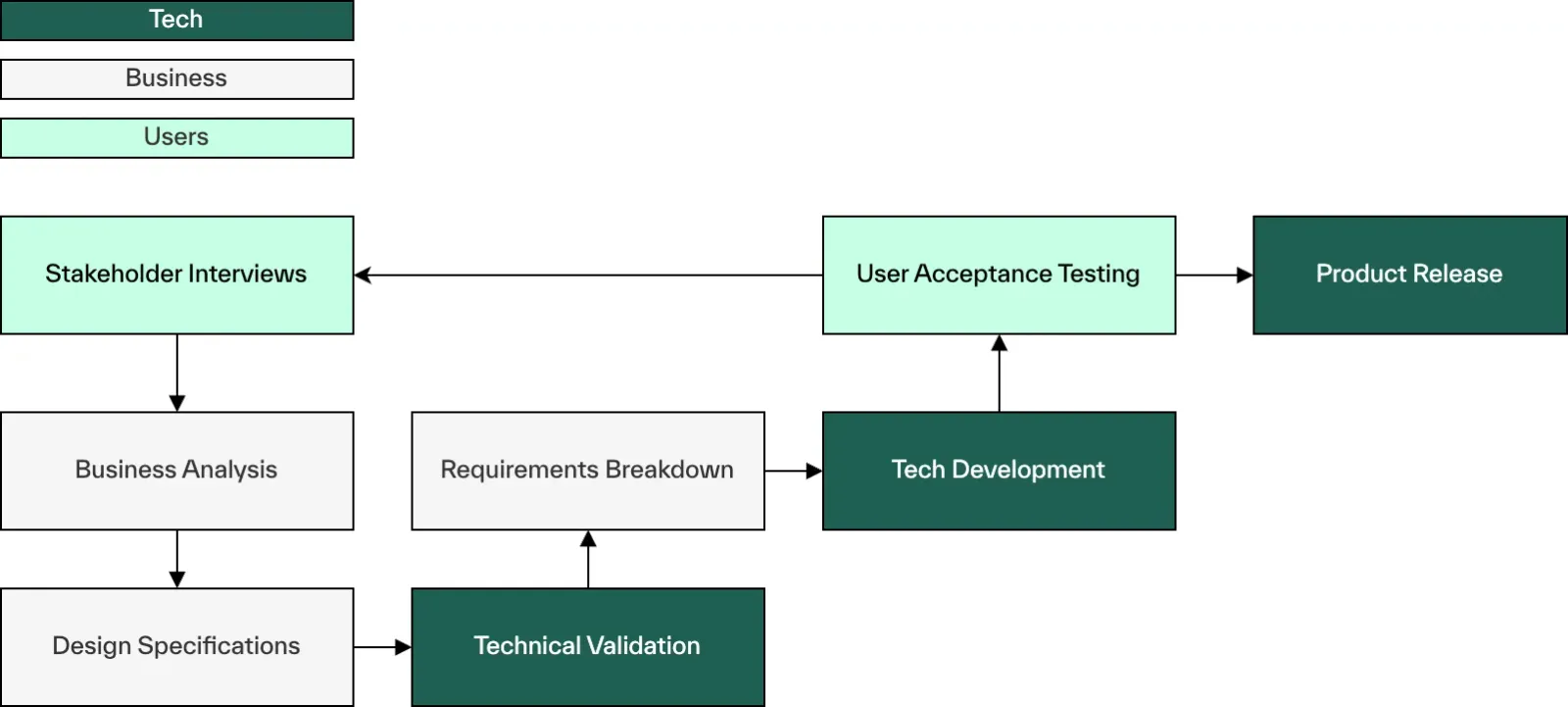
This structure had one major advantage: predictability. As long as every party clearly understood and translated the inputs from the step before, the machine moved smoothly.
But that's a fragile assumption.
Misinterpretations, even minor ones, tend to cascade. And by the time an idea reaches the execution layer, it often bears only a faint resemblance to the original intent.
The result? Engineering calories are spent building things that don't solve the actual business problem. The closer technical teams are to the business, the more accurate and impactful the output becomes.
How AI is changing the paradigm?
By Q1 2025, it's clear we've passed an inflection point.
What used to be speculative ("AI might replace developers") now feels less far-fetched. Tools like Cursor, Windsurf, and others show just how effectively AI can navigate and generate codebases with high context awareness and precision.
To put it simply, there a way more things which can be generated by AI from with minimum instructions based on the context environment (ChatGPT memory, CodeBase scanning, meta-instructions).
This changes two fundamental dynamics in software development:
- Fewer engineers are needed for repetitive tasks → Less delegation to mid-tier engineering
- More time is available for business alignment → Less need for layers of translation and management
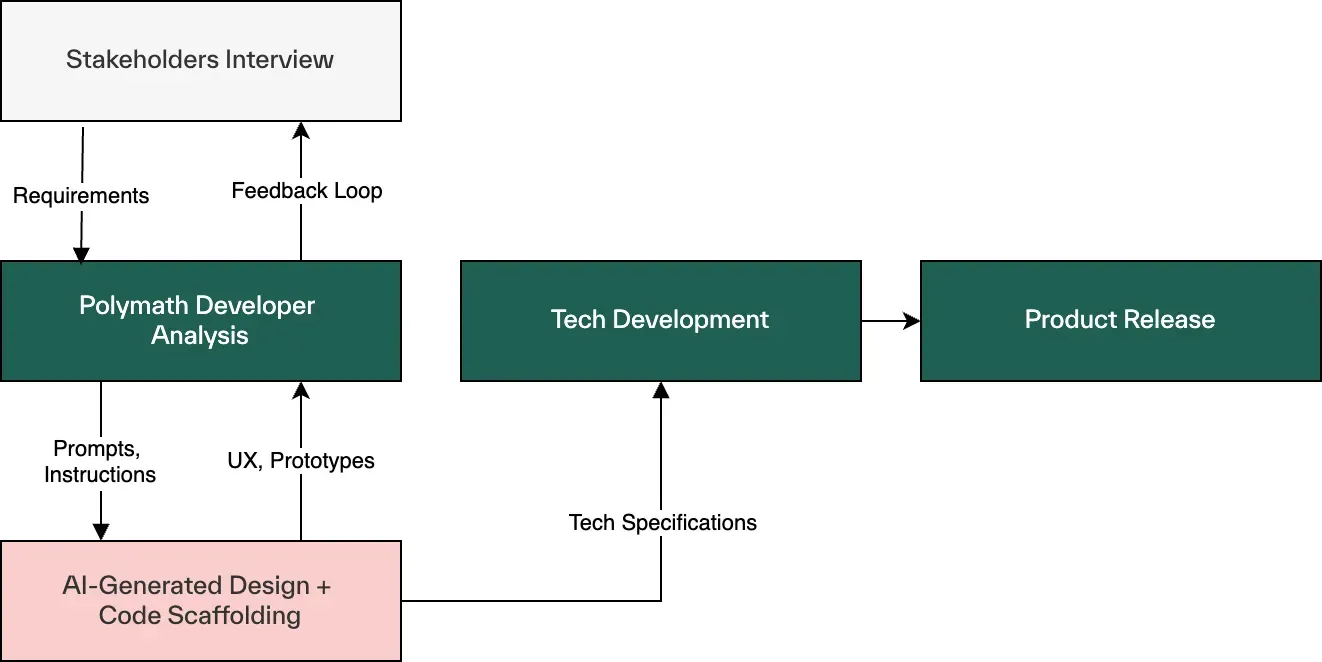
Now add to that tools like Claude Sonnet 3.7 or V0 by Vercel, which can scaffold functional UX interfaces without the need for initial design input and you get rid of another layer of the initial requirements funnel.
So at the end if we combine those things together you basically move Tech experts up into the funnel as they need less time and less dependency on other parties to generate immediate feedback loop on business. Entropy goes down, productivity goes up.
The big question is "But will development hours decrease?"Not in the near future. What will change is what those hours are spent on.
The future of AI-driven Product Teams
While many fear AI will eliminate jobs, something different will happen.
Senior Developers will become more fulfilled, because they're no longer stuck delivering outputs disconnected from business reality. They will transition into business context and will be more connected to the business.
Instead of fixing misaligned specs or chasing handoffs, engineers are finally working on problems that matter. They're solving, not translating. We will see the trend of engineers working more on things what matter and less on in-depth troubleshooting.
When AI handles 90% of the coordination scaffolding, teams no longer need fragmented roles to move an idea forward. That reduction in cognitive and process overhead makes room for creativity, agility, and purpose.
But this only works if you change how you work
There's a catch here that's easy to miss. Moving engineers up the funnel doesn't happen just because the tools got good. It happens when you change the actual habit, and the habit I keep coming back to is simple: write more, code less. The more I write the intent out by hand, the better the result on the other side. That might be a clear instruction, a few sentences of context, or sometimes just thinking out loud into a voice note. The less I hand-write the code itself, the more the work feels like steering instead of typing.
This feels backwards until you try it. The instinct is to jump straight into the code, but the leverage sits in the words before the code. A precise paragraph of intent is worth more than an hour of keystrokes, because it's the part AI can't invent for you. It doesn't know your customer, your constraints, or what "done" actually means in your context.
You pay for decisions, not keystrokes
Once that clicks, the split becomes obvious. Boilerplate is exactly what AI should be doing: the screens, the glue between services, the repetitive scaffolding. The new and load-bearing parts are different. The architecture, and the places where a wrong call is expensive, still need a human who can see the shape of the thing, notice when the AI writes something crooked, and fix it. You can't guardrail your way out of this; the model doesn't carry enough of your context to make those calls from a prompt, and it won't.
So what are you really buying when you hire a team that works this way? Not lines of code, those are close to free now. You're buying the decisions: what to build, what to refuse, where the real risk actually lives. That's the work that stays valuable while everything around it gets cheaper.
The engineer this rewards
This is also why the engineer who does well in this setup looks different from the one who did five years ago. The ones who thrive take a vague business problem and carry it end to end. They ask the right questions, set the thing up themselves, wire it into whatever it needs to touch, and come back with an outcome instead of a list of blockers. When AI takes the busywork off the table, what's left is judgment and ownership, and those are the people worth building a team around.
What This Means for Product Teams
- Teams will be leaner, yet more effective
- Developers will be closer to the business, not hidden behind layers
- Iteration will speed up, and with it, innovation
- Entropy, in both communication and process, will be systematically reduced
We'll spend less time clarifying requirements and more time delivering impact.